


Getting rejected after a job interview is one of the more quietly painful experiences in a person's professional life. You did the work. You researched the company, prepared your answers, showed up ready, and gave it your all. And then the email came. Or worse, the silence did.
It stings. That is normal, and it is allowed to sting. But what you do in the days after a rejection matters far more than the rejection itself. The professionals who build strong, lasting careers are not the ones who never get rejected. They are the ones who refuse to let rejection be the end of the story.
Here is how to move forward with intention.
Ask for Feedback Before You Walk Away
Most job seekers accept a rejection and move on without ever asking why. This is one of the most significant missed opportunities in the entire job search process. Feedback from an interviewer is direct, specific, and more valuable than anything you can learn from a career blog or a practice session with a friend.
Not every interviewer will respond, and not every response will be detailed. But some will tell you exactly where the disconnect was, whether it was a gap in your experience, the way you answered a specific question, or simply the fact that another candidate was a stronger match for that particular role at that particular time. Any of those answers gives you something to work with.
If the initial feedback feels vague, follow up. Ask whether there is anything specific you could have addressed differently or any area where the stronger candidate stood out. The worst they can say is nothing. The best they can do is hand you the exact information you need to perform better next time.
Reflect Honestly Without Being Harsh on Yourself
After you have gathered any available feedback, it is time to sit with the experience and examine it honestly. Not to punish yourself, but to learn from it in a way that actually sticks.
Think back through the entire interview. How thoroughly did you research the company before walking in? Were you genuinely prepared for the questions that came up, or did some of them catch you off guard? Did you communicate your experience clearly and confidently, or did you find yourself fumbling through answers you thought you knew? Were there moments where you felt the conversation shift, and if so, what preceded them?
The goal of this reflection is not to arrive at a verdict about your worth as a candidate. It is to identify the specific, actionable things you can do differently. Write them down. Keep them somewhere you will see them before your next interview. Reflection that lives only in your head tends to fade. Documented reflection becomes a tool.
Turn the Gap Into a Plan
Sometimes a rejection reveals something more significant than a bad interview day. Sometimes it reveals a real gap between where you are and where you want to be, and that is not a reason to give up. It is a reason to get specific about what needs to change.
If the feedback points to a lack of experience in a particular area, look for ways to build that experience in your current role or through volunteer work. If it points to a credential or certification you do not have, research what it would take to get it and whether the investment makes sense for the direction you are heading. If it points to something about how you present yourself, invest in that. Practice. Record yourself. Work with a mentor or a coach.
Rejection has a way of showing you exactly what your next step needs to be, if you are willing to look at it that way. The professionals who grow the fastest after a rejection are the ones who treat it as a map rather than a dead end.
Build the Kind of Resilience That Keeps You Moving
Here is the truth about job searching that nobody often says out loud: rejection is part of the process for almost everyone.
It is not a sign that you are unqualified, unlikable, or on the wrong path. It is a sign that you are in the arena, putting yourself out there, and doing the work that most people are too afraid to do consistently.
The danger is not in getting rejected. The danger is in letting rejection slow your momentum. Every day spent replaying the interview, questioning your worth, or hesitating to apply for the next opportunity is a day when your job search stands still. Resilience in a job search does not mean pretending rejection does not hurt. It means feeling it, learning from it, and choosing to keep going anyway.
Give yourself the time you need to process it. Then redirect that energy toward what is next.
Take an Honest Look at Where You Are Applying
Finally, one of the most productive things you can do after a string of rejections is to step back and evaluate the roles you are pursuing. Are the positions you are applying for a genuine match for your current experience and qualifications? Are you consistently seeking roles that require credentials or experience you have not yet developed?
If so, that is not ambition working against you. That is misalignment, and it is fixable.
Narrowing your focus to roles that align with where you are right now does not mean lowering your standards. It means being strategic. Landing a role that is the right fit for your current level gives you the experience, the confidence, and the track record to pursue the roles you are ultimately working toward. There is a path to where you want to go. Make sure the steps you are taking are actually on it.
At Citrus Careers, Your Next Opportunity Is Waiting.
A rejection is not a reflection of your potential. It is a moment in a journey that is still very much in motion. At Citrus Careers, we exist to ensure that when you are ready to take your next step, the opportunities waiting for you are real, fully remote, and worth every bit of the effort you put in.
Your career does not end with a rejection. At Citrus Careers, it gets better from here.
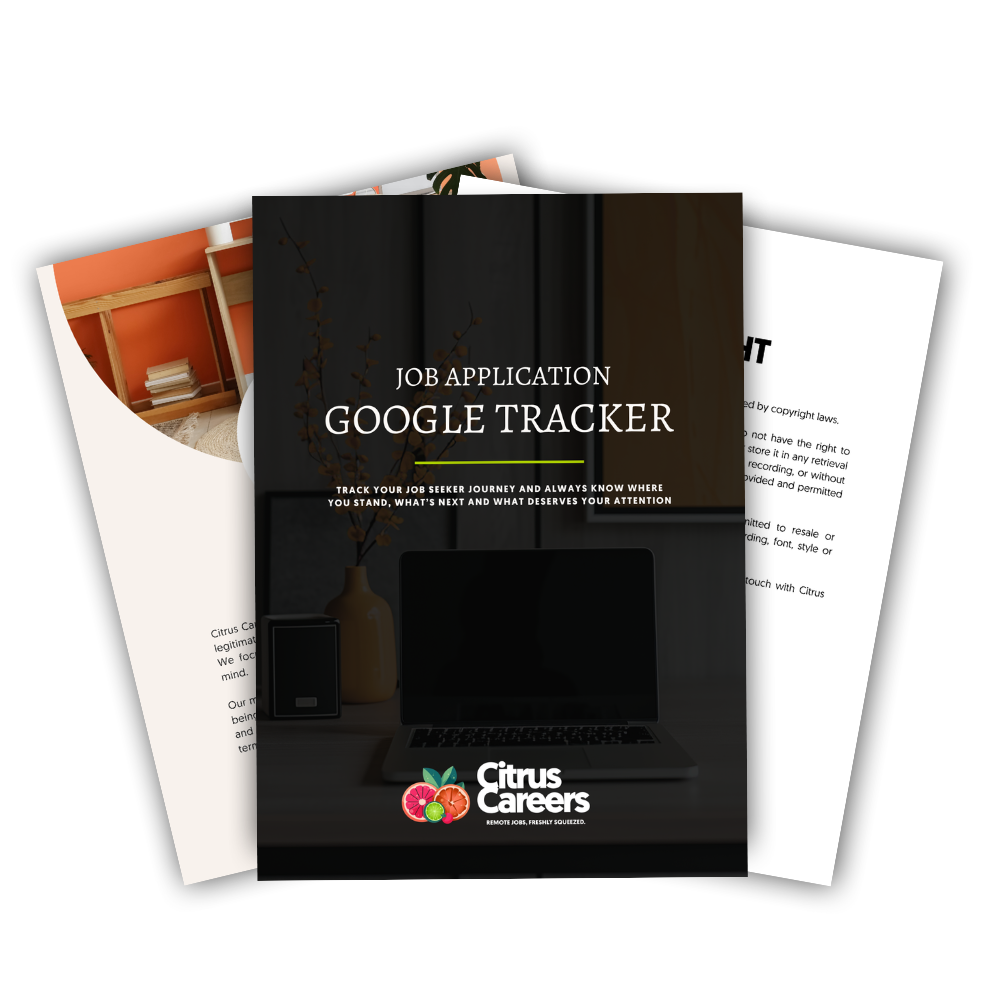
Google Job Application Tracker Spreadsheet
Organize all of your resume submissions while keeping up with when, how and where you applied. Never miss a moment to follow-up with a recruiter.